Hidden Pieve Tesino. The Story of 19th-Century Print Merchants in an App

Between the 17th and 19th centuries, travelling vendors and print merchants from the Tesino Plateau sold printed images, and opened presses and stores, throughout Europe, driven by both economic necessity and commercial opportunities. These family and community histories—which touch on the history of mobility as well as social, economic, and cultural history—have been the studied for over fifty years. Since 2014, these stories have been showcased at the Museo Per Via di Pieve Tesino and are now embedded in the cultural heritage and tourist offer of the Tesino Plateau and Trentino.
Hidden Pieve Tesino is an app created by the Italian-German Historical Institute of the Bruno Kessler Foundation in Trento and funded by NEXT GENERATION EU, the Italian Republic—Ministry of Culture, the Municipality of Pieve Tesino, and the PNRR Project “Pieve Tesino Borgo d’Europa”. The app offers a further opportunity to explore these stories. Launched in the summer of 2026, the app presents and promotes the latest research on the print trade and Tesino’s travelling vendor tradition from the modern to the contemporary era, and it is free to download from the Apple and Googleplay app stores. It is part of the European HistoryCity Apps family, developed by the University of Exeter, and was created by ISIG with the University of Exeter, in collaboration with the Alcide De Gasperi Trentino Foundation, Per Via: Tesino Museum of Prints and Travelling Sellers, and the Daziaro-Gaudenzi Foundation.
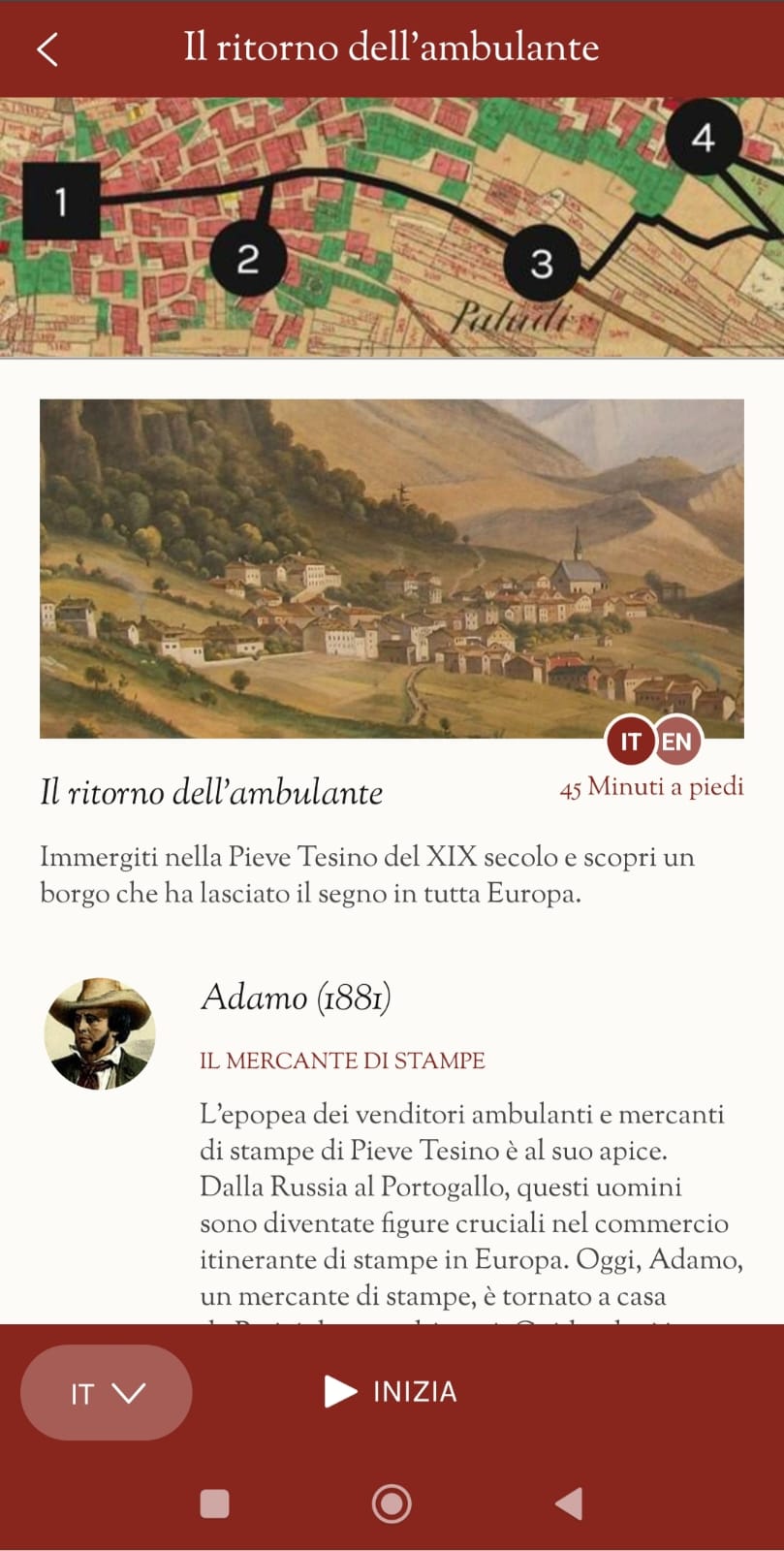
The app, available in Italian and English, offers a walking tour guided by a historical figure, a print dealer called Adamo, who leads users through the streets and squares of Pieve Tesino in the year 1881. Adamo’s narration is enriched by archival documents, prints, and images. With their smartphone, the app user can follow the trail on a georeferenced mid-19th-century historical map from the Austrian Land Registry, with site points activated via GPS.
The six-stop route, titled “The Return of the Merchant,” begins at Piazza Garibaldi and lasts about 45 minutes, but can also be experienced remotely. During the walking tour, users are invited to identify architectural features linked to the history of 19th-century print dealers, such as Villa Daziaro, whose revitalization was achieved through the “Pieve Tesino Borgo d’Europa” project (https://www.pievetesinoborgodeuropa.it/). Users can also download the app and read more about it on the HistoryCity website: Historycityapps.
Hidden Pieve Tesino is a digital public history tool designed to explore the history of travelling vendors and print merchants in connection with the museums of Pieve Tesino. It promotes archival research and awareness of local cultural and architectural heritage in a form that is highly accessible; it encourages outdoor activities to discover one of Italy’s most beautiful villages.
Free Download
Persone
Massimo Rospocher (direttore FBK-ISIG) – P.I.
Fabrizio Nevola (University of Exeter)
Marco Odorizzi (direttore Fondazione Trentina Alcide De Gasperi)
Alessandro Paris (FBK-ISIG)
David Rosenthal (HistoryCity Apps – University of Exeter)